
The US Electoral System Has Been Compromised
Liberty Vote, DOGE, and Palantir — How the Machines That Count Your Votes Ended Up in the Hands of the MAGA Movement

by The Democracy Defender
Listen or download this article:
PDF - Share this with your representatives (Links in “What Can You Do” section)

Did MAGA just buy your election system?
In October 2025, the second-largest voting machine company in the United States was sold.
No congressional hearing. No federal security review. No background check on the buyer. The company that manufactures, programs, and maintains the machines used to count ballots in twenty-seven states — including Georgia, Michigan, and Pennsylvania — changed hands with less government oversight than it takes to open a bar.
That is not an exaggeration. When New Hampshire’s Ballot Law Commission questioned the deal, commissioners noted on the record that a liquor license application receives more scrutiny than the purchase of America’s election infrastructure.
The buyer is Scott Leiendecker, a former Republican elections director from St. Louis, Missouri. His new company is called Liberty Vote. His first public statement:
“As of today, Dominion is gone.”
That line was not written for election administrators. It was written for the MAGA base. And the base heard it loud and clear.
Liberty Vote’s launch was a political rally disguised as a corporate press release. The company declared itself “100% AMERICAN OWNED” — a dog whistle aimed directly at the conspiracy theories that spent five years accusing Dominion of being controlled by Venezuelan dictators and German servers. It pledged to deliver “hand-marked paper ballots” and align its technology with Donald Trump’s executive orders on election standards. The rhetoric wasn’t subtle. It wasn’t meant to be.
But here’s what the press release didn’t mention.
Leiendecker already owns KNOWiNK — the largest electronic pollbook company in America. Pollbooks are the tablets poll workers use to check you in, verify your identity, and confirm your registration before you cast a ballot. KNOWINK’s systems are deployed in jurisdictions across the country.
Now the same man controls what happens when you walk into a polling station and what happens after you drop your ballot in the box. From check-in to count. One person. One political alignment. One unbroken chain of custody over your vote.
Nobody in the federal government reviewed this arrangement.
And while Leiendecker was quietly locking in decade-long municipal contracts — Like: Napa County through 2032, Contra Costa County through 2032, Gwinnett County in Georgia renewed just last week — something far more dangerous was happening on the other side of the equation.
The federal government was building a system to decide who gets to vote in the first place.
Here’s what you need to understand before we go any further.
After Watergate, the United States built a system of legal firewalls to prevent the federal government from ever again creating a centralized database of its citizens. The Privacy Act of 1974 deliberately siloed government data — your tax records at the IRS couldn’t be cross-referenced with your health records at HHS, your Social Security file couldn’t be merged with your immigration status, your employment history couldn’t be fused with your voting record. These walls were built for a reason. They were the lesson a democracy learned after it caught its own president using federal agencies to spy on political opponents.
In 2025, Trump operatives quietly demolished those walls.
The Department of Government Efficiency — DOGE — arrived at federal agencies with a presidential order granting “full and prompt access to all unclassified agency records.” What followed was not an efficiency review. It was a data harvest. DOGE operatives accessed the IRS, the Social Security Administration, the Department of Education, Veterans Affairs, and Health and Human Services. They held a multi-day “hackathon” with engineers from Palantir Technologies — a private surveillance company co-founded by billionaire Peter Thiel with seed money from the CIA — to build a single interface that sits on top of all IRS databases. The post-Watergate firewalls weren’t breached. They were architecturally removed.
Palantir is now building what amounts to a master database of American citizens — reportedly ingesting 314 distinct data points per person, including Social Security numbers, bank accounts, medical records, criminal history, and voting records. The company that started as a tool for hunting terrorists is now the operating system through which the federal government sees its own people.
This article is about the other half of the story. The hardware — Liberty Vote — is one side. The software — DOGE and Palantir — is the other. And they converge at the ballot box.
Here is what this article will show you:
This is not a story about a corporate acquisition. It is a story about the capture of democratic infrastructure by a partisan political movement, executed simultaneously from two directions. From the outside, a MAGA-aligned operative purchased the machines that count America’s votes and merged them with the systems that verify who gets to vote — creating a vertical monopoly over the ballot from check-in to count. From the inside, the federal government smashed decades-old data privacy firewalls, exfiltrated the Social Security records of hundreds of millions of Americans onto unauthorized servers, signed a secret deal with an election denial group to audit voter rolls, and deployed federal criminal investigators to replace the local officials who have run elections since the founding of the republic.
The 2026 midterm elections will be the first American election conducted under this architecture. The agency that was supposed to protect election security has been gutted. The courts are still catching up. And the contracts are already signed through 2032.
This is a warning. Here are the facts.
The Buyout
To understand what Liberty Vote is, you need to understand what Dominion Voting Systems was — and why it was for sale.
Dominion was founded in Toronto in 2002. By 2020, its optical scanning machines counted ballots in twenty-eight states, including every swing state that mattered. Then Donald Trump lost the election and Dominion became the target of the most sustained corporate disinformation campaign in modern American history. Trump’s allies accused the company of running Venezuelan algorithms that flipped votes. They claimed its servers were hidden in Germany and Spain. None of it was true. Every audit, every recount, every independent cybersecurity review confirmed the same thing: the machines worked.
Dominion fought back. It sued Fox News and won a historic $787.5 million defamation settlement in 2023. It sued Newsmax for $67 million. It settled with Rudy Giuliani, Sidney Powell, and One America News. The company won every legal battle it entered.
But it lost the only war that mattered. Public opinion. The brand was dead.
In Republican-controlled jurisdictions, “Dominion” had become a curse word. County commissioners who renewed Dominion contracts faced death threats. State legislatures passed resolutions demanding alternatives. CEO John Poulos publicly described the company as being in a “death spiral” — not because the technology failed, but because the conspiracy theories made the name politically radioactive.
Dominion’s majority owner, the private equity firm Staple Street Capital, had bought its 76% stake for $38 million in 2018. By 2025, thanks to the Fox News settlement alone, the firm had made twenty times its investment. They wanted out. The brand was toxic, the returns were banked, and somebody was willing to buy the corpse.
That somebody was Scott Leiendecker.
On October 9, 2025, election administrators across twenty-seven states learned — most of them through the media, not through Dominion — that the company they relied on to count their votes had a new owner, a new name, and a new political identity. Those twenty-seven states aren’t clustered on one side of the aisle. They include deep-blue California, where forty-four counties run Liberty Vote machines. Blue-leaning Michigan and Pennsylvania. Purple Georgia. Red-leaning Florida, where eighteen counties use the systems. Colorado, where sixty out of sixty-four counties are dependent on them. The footprint spans the entire political map — and every critical swing state that will decide the 2026 midterms.
County clerks were blindsided. Voters began calling their local offices asking if elections would even continue. La Plata County Clerk Tiffany Lee in Colorado fielded frantic calls from constituents convinced it was a “GOP takeover.”
Behind closed doors, Liberty Vote told a different story. In private communications to Georgia officials, the company assured administrators: “Same team, same support, different name.”
Two faces. One for the MAGA base: revolution. One for the bureaucrats: business as usual.
Both were strategic. And both were working.
The Man Behind the Machine
Scott Leiendecker is not a household name. That’s by design.
He spent seven years as the Republican director of elections for the City of St. Louis, from 2005 to 2012. He was hired into that position by Ed Martin, who at the time served as chairman of the St. Louis Board of Election Commissioners. We’ll come back to Ed Martin. You’ll want to remember that name.
After leaving election administration, Leiendecker founded KNOWiNK in 2011 — a technology company that builds electronic pollbooks. These are the tablet-based check-in systems that poll workers use to verify your identity, confirm your registration, update your voting history, and issue your ballot. If you’ve checked in on an iPad at a polling station, there’s a good chance you were interacting with Leiendecker’s software.
Scott Leiendecker’s KNOWiNK grew rapidly and now dominates the American pollbook market. It is backed by a sophisticated network of Silicon Valley venture capital firms — New Enterprise Associates, OS Fund, and AME Cloud Ventures (founded by former Yahoo CEO Jerry Yang). This is not a garage startup. This is a well-funded, well-connected enterprise operating at the nexus of technology, politics, and election administration.
Now think about what Leiendecker assembled. KNOWiNK controls the front end — the moment you walk in, identify yourself, and receive a ballot. Liberty Vote controls the back end — the machine that scans your ballot, tabulates your vote, and transmits the result to the Secretary of State. Under two technically separate corporate entities, both controlled by the same man, the entire mechanical lifecycle of your ballot is now a closed loop.
And these systems are not bulletproof. KNOWiNK’s pollbooks have caused severe failures in jurisdictions across the country — system crashes, extended wait times, and cascading bottlenecks in Georgia, Philadelphia, Los Angeles County, Ohio, and Texas. In April 2025, a critical security vulnerability was discovered in a KNOWiNK pollbook in Ohio. The breach risk was deemed so severe that the Ohio Secretary of State issued an emergency order compelling multiple counties to immediately abandon the digital pads and revert to paper pollbooks. The man who now owns both the check-in system and the tabulation system already has a documented infrastructure failure on his record — and nobody with federal authority reviewed whether he should be allowed to acquire even more.
When New Hampshire’s Ballot Law Commission pressed Liberty Vote’s VP of Certification, Robert Giles, on exactly why Leiendecker acquired Dominion, Giles deflected. The question, he said, “would have to be asked of Leiendecker himself.”
He hasn’t answered it.
And here’s what else he hasn’t answered. We attempted a full biographical investigation of the man who now controls a quarter of America’s election infrastructure. What we found is nothing… a ghost:
Career before 2005: Nothing verifiable. Corporate bios reference “decades of experience in election technology.” No employer, no industry, no role confirmed.
Military service: None found.
Net worth: Unknown. No real estate holdings, luxury assets, or financial disclosures in public record.
Marriage and family: No public record. No corporate biography mentions. No media references.
Political activity: No documented attendance at any Trump event, Mar-a-Lago function, CPAC, Republican National Convention, or Heritage Foundation gathering. No Federalist Society membership. No Council for National Policy affiliation.
Social media: Zero personal political statements. Entire public footprint confined to Liberty Vote and KNOWiNK corporate messaging.
Public interviews: Almost none. When Colorado clerks confronted him directly and asked if he personally believed election conspiracy theories, he said no — in private, behind closed doors.
For the owner of a mid-size business, this would be unremarkable. For the sole proprietor of the machines that count America’s votes — deployed across 27 states including every swing state — it is extraordinary. The public has a right to know who this person is. The fact that we cannot answer basic biographical questions about him is itself an indictment of the regulatory framework that allowed this acquisition to proceed.
The People Around the Table
The full picture doesn’t emerge from Leiendecker alone. It emerges from the people he hired, the people who hired him, and the people who showed up in federal positions at exactly the right time
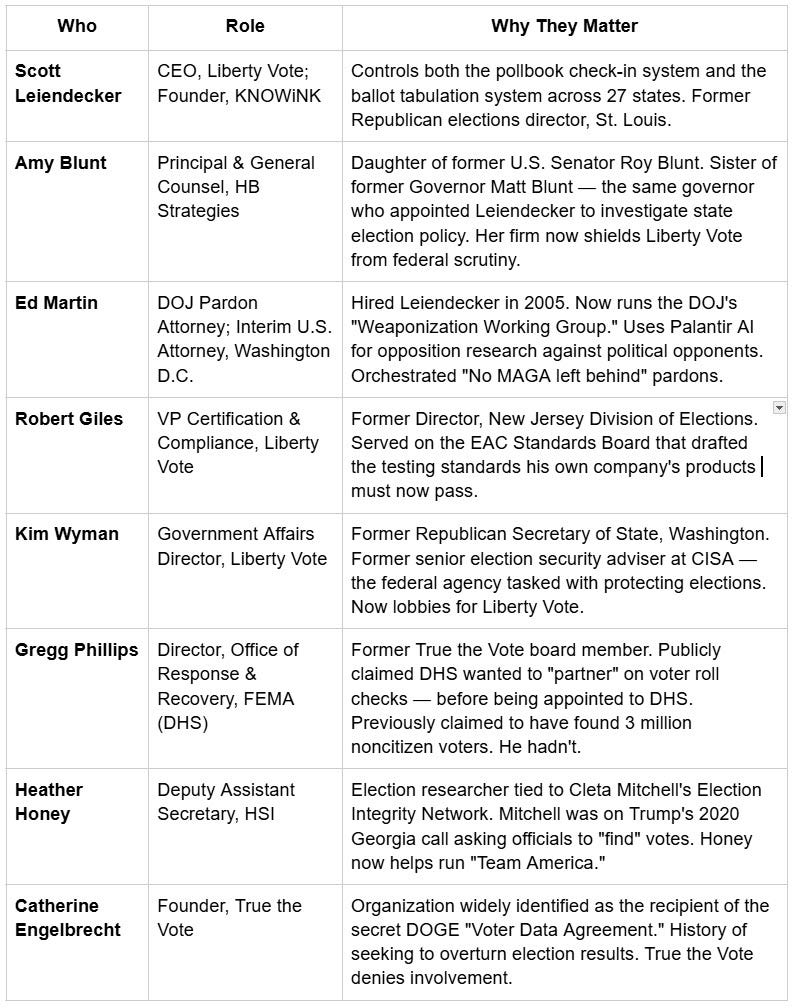
Amy Blunt’s entry requires its own explanation, because behind it sits an entire political dynasty.
The Blunt Dynasty
Roy Blunt was a United States Senator and Missouri Secretary of State — literally the state’s chief election officer. His son Matt was Governor of Missouri, and personally appointed a young Scott Leiendecker to investigate statewide election policy. His daughter Amy is now the Principal and General Counsel for Compliance at HB Strategies — the firm Leiendecker retained on February 4, 2026, to lobby on Liberty Vote’s behalf. Her brother Andy Blunt founded the firm. And the lead lobbyist on the Liberty Vote account is Stacy McBride — Roy Blunt’s former Chief of Staff.
This is not a lobbying relationship. It is a multigenerational political system wrapped around election infrastructure. The family that ran Missouri’s elections for decades is now being paid to ensure that nobody in Washington looks too closely at the man who bought the nation’s.
Look at the pattern. Election deniers are being appointed to the federal agencies whose data they wanted to weaponize. The woman who helped draft CISA’s election security protocols now lobbies for the company that bought the voting machines. The man who hired Leiendecker two decades ago now runs a DOJ unit that uses Palantir’s AI to target political opponents.
These are not coincidences. This is a personnel architecture.
The Financing Black Box - (Dark Money Alert!)
How does a former city elections director privately finance the purchase of a company valued at three quarters of a billion dollars?
That’s the question nobody has answered.
Dominion’s enterprise value was estimated at approximately $741 million before the Fox News settlement. After collecting nearly $900 million in total defamation payouts, Staple Street Capital was sitting on a massively appreciated asset. The exact purchase price has not been disclosed. Leiendecker claims Liberty Vote is entirely privately financed and that he is the sole owner.
Where did he get the money?
KNOWiNK’s venture capital backing — NEA, OS Fund, AME Cloud Ventures — represents a sophisticated capital network. But the gulf between a pollbook company’s revenues and a billion-dollar acquisition is vast. KNOWiNK reported $53.7 million in annual revenue in 2019 and received a $10 million private equity injection from Hermann Cos. in 2020. That math does not add up to a sole-proprietor buyout of a company worth three quarters of a billion dollars. Forensic searches of Delaware corporate filings, Colorado Secretary of State records, and UCC filings turn up no documented mezzanine debt, convertible notes, or special purpose vehicles associated with the transaction.
This is a classic dark money funding structure.
And then there’s the layer beneath the layer. Venture capital funds like NEA don’t invest their own money — they pool capital from Limited Partners: pension funds, endowments, sovereign wealth funds, family offices, and other VC firms. Those Limited Partners are almost never publicly disclosed. Analysis of NEA’s investment profile reveals dense co-investment history with Andreessen Horowitz and Sequoia Capital — and a16z’s “American Dynamism” portfolio is explicitly designed to fund private companies operating in defense, intelligence, and civil administration. Peter Thiel’s Founders Fund occupies the same ecosystem. The question isn’t whether visible Silicon Valley money backed KNOWiNK. It did. The question is whose money is inside those funds — and whether that money has a name, a political agenda, and a reason to want the machines that count America’s votes under friendly management.
Speculation has centered on Peter Thiel’s Founders Fund, Andreessen Horowitz, and other MAGA-aligned Silicon Valley money. No direct investment from any of these entities into Liberty Vote has been confirmed. But the opacity is itself the point. When a former Republican elections director acquires a critical piece of democratic infrastructure with undisclosed financing, brands it with MAGA rhetoric, and hires a roster of partisan operatives — the burden isn’t on the public to prove where the money came from. The burden is on him to show us.
He hasn’t.
And in Trump’s current regulatory environment, nobody can make him. Because the system designed to catch exactly this kind of acquisition doesn’t apply.
The Committee on Foreign Investment in the United States — CFIUS — exists to review national security threats from foreign acquisitions of critical infrastructure. When the Venezuelan-linked company Smartmatic tried to buy Sequoia Voting Systems in 2006, CFIUS forced a complete divestiture. But CFIUS only has jurisdiction over foreign buyers. Because Leiendecker is a U.S. citizen and Liberty Vote loudly declares itself “100% American Owned,” the entire federal national security review apparatus was legally bypassed.
A domestic partisan actor can acquire a near-monopoly on election technology without triggering a single federal alarm.
That is the loophole. And Leiendecker and Liberty Vote drove straight through it.
The Voter Data Pipeline
While Leiendecker was assembling the hardware side of the equation, the federal government was building the software.
On January 20, 2025 — inauguration day — Donald Trump signed Executive Order 14158, ordering every federal agency to give the newly created Department of Government Efficiency “full and prompt access to all unclassified agency records.” DOGE was sold to the public as a cost-cutting operation. An efficiency drive. Elon Musk’s team was going to find the waste and trim the fat.
What happened next was far from an efficiency drive.
DOGE operatives arrived at the Social Security Administration and demanded access to the most sensitive repository of American identity data in existence — the Numerical Identification System, known as NUMIDENT. This database contains the records of every Social Security number ever issued. Over 450 million entries. Birth dates, parent names, citizenship status, historical records. The foundational data layer of American civil identity.
According to whistleblower testimony from Charles Borges, the SSA’s former Chief Data Officer, DOGE operatives didn’t query the database for specific fraud indicators. They copied the entire thing. A wholesale, unredacted duplication of the complete NUMIDENT dataset, transferred to an external cloud environment controlled exclusively by DOGE — locking out the SSA’s own security monitors.
They used Signal to coordinate — the encrypted messaging app whose signature feature is automatic message deletion, specifically designed to leave no recoverable record of conversations. They used Cloudflare servers to host the data. They bypassed every federal cybersecurity protocol designed to prevent exactly this.
Then it got worse.
On March 24, 2025 — four days after a federal judge issued a restraining order to halt DOGE’s access to SSA records — a DOGE operative sitting inside the SSA signed a document called the “Voter Data Agreement.” This was a formal arrangement to share sensitive federal data with an outside political advocacy group. Court filings and congressional investigations have identified that group as True the Vote — an organization whose explicit mission is to find evidence of voter fraud and overturn election results.
The agreement was clandestine. It wasn’t reviewed through the SSA’s data exchange procedures. The agency didn’t know it existed until an unrelated internal review eight months later, in November 2025.
An encrypted, password-protected file was generated and emailed to Steve Davis — a senior DOGE advisor and known associate of Elon Musk. The Department of Homeland Security later determined the file contained the names, addresses, and sensitive records of approximately 1,000 individuals drawn from SSA systems. Because the file was encrypted and the SSA did not possess the password, the agency admitted it could not verify the exact contents — or whether Davis ever opened it.
The chain of custody for American citizens’ data was destroyed.
The cover-up lasted until January 16, 2026, when the Department of Justice — defending the administration in the ongoing AFSCME v. SSA lawsuit — was forced to file a “Notice of Corrections to the Record.” The DOJ admitted that prior sworn declarations by senior SSA officials had been false. They had misled the court about the extent of DOGE’s access, the existence of the voter data agreement, and the use of unauthorized servers.
On April 10, 2026, the Fourth Circuit Court of Appeals issued its ruling. The court described the government’s conduct, its secret agreements, and its shifting explanations as “alarming.”
On April 14, 2026, federal Judge Ellen Lipton Hollander ordered sweeping discovery — forcing DOGE and the SSA to surrender all internal communications, emails, and sworn testimony related to the breach.
That discovery is ongoing right now.
Team America
The voter data pipeline doesn’t end at DOGE. It feeds into something far more dangerous.
Inside the Department of Homeland Security, a group of political appointees has been operating under an internal codename: “Team America.” Their mission, exposed by a ProPublica investigation on April 13, 2026, is to divert Homeland Security Investigations agents — the federal officers traditionally tasked with dismantling human trafficking networks, intercepting cartel smuggling, and protecting children from exploitation — away from those missions and toward a new priority.
Auditing voter rolls.
Team America is led by David Harvilicz, an HSI Assistant Secretary, and Heather Honey, a Deputy Assistant Secretary and election researcher with direct ties to Cleta Mitchell’s Election Integrity Network. Mitchell is the lawyer who was on the phone when Donald Trump pressured Georgia officials to “find 11,780 votes” in January 2021. Her network now has personnel inside the federal law enforcement agency being used to police American elections.
The mechanism works like this: the Department of Justice demands unredacted voter registration lists from states. California alone was asked to hand over nearly 23 million records — names, Social Security numbers, addresses, party affiliations, voting histories. The DOJ has admitted to checking at least 47.5 million voter records nationwide. Internal DOJ communications revealed concerns among career lawyers that the data wasn’t being used for routine list maintenance — it was being used to build a national voter roll.
That data feeds to DHS. DHS hands it to HSI’s “Team America.” And instead of using the administrative SAVE database — the standard, low-level system designed to verify immigration status for benefit eligibility — Team America deploys HSI’s full criminal enforcement powers. Federal subpoenas. Criminal investigations. Prosecutorial referrals. Aimed at voters.
This is the paradigm shift: the administration has replaced civil election administration — traditionally run by bipartisan local boards — with federal criminal enforcement. The same government that exfiltrated your Social Security data onto an unauthorized server is now using that data to decide whether you belong on a voter roll.
During congressional hearings, Senators Jon Ossoff and Ron Wyden demanded to know why agents were being pulled off child exploitation cases to audit voters. DHS denied any political motivation, claiming its hiring process is “rigorous” and aimed solely at “keeping elections secure.”
But Harvilicz and Honey have provided private briefings to outside advocacy groups. The door between government enforcement and partisan activism isn’t just revolving.
It’s been removed.
Killing the Watchdog
For this architecture to work, every institution designed to stop it had to be neutralized. And they were — systematically.
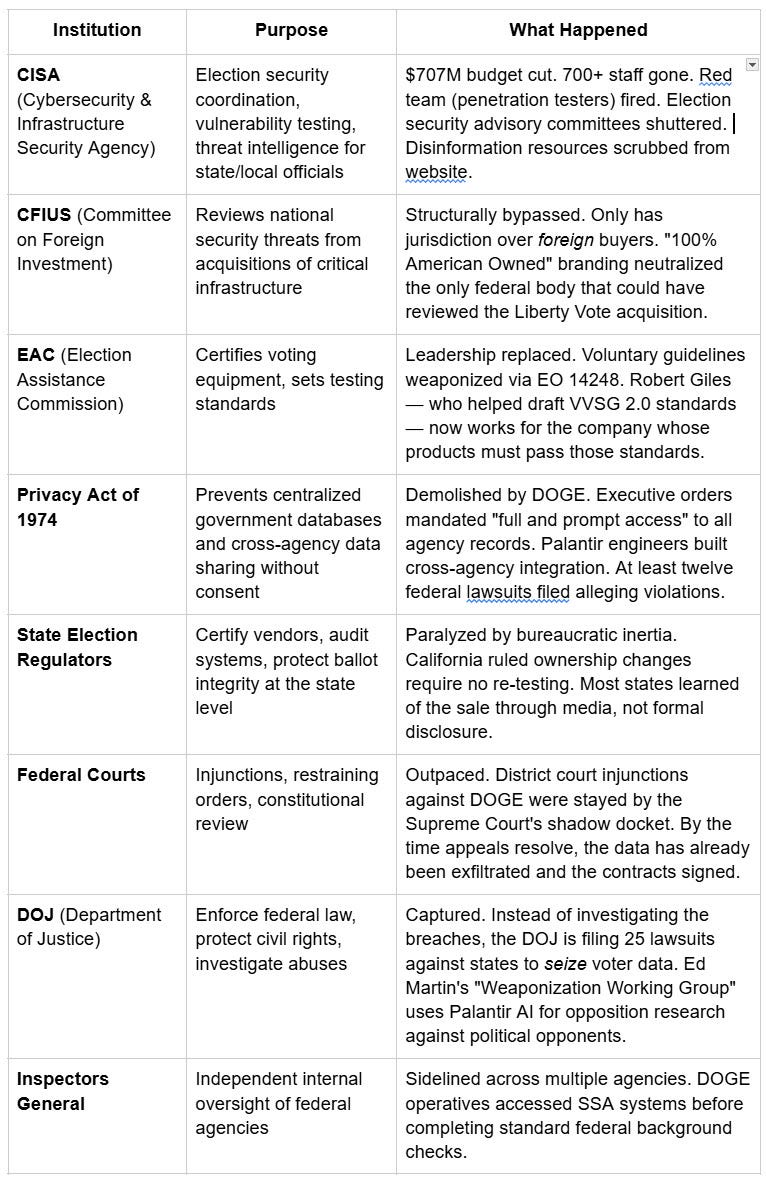
Every door that was supposed to stop this was either locked from the inside, kicked off its hinges, or simply didn’t have jurisdiction. This is not an oversight failure. This is a checklist.
The details matter. CISA — the agency that coordinated election security for thousands of counties and municipalities that can’t defend their own infrastructure — has been hollowed out so thoroughly that Secretary of Homeland Security Kristi Noem now calls its dismantling a “return to mission.” She characterized its prior election security work as operating a “Ministry of Truth.” The municipalities that relied on CISA grants and expertise to harden their election systems are now on their own — at the exact moment when a partisan actor is locking in decade-long contracts to run those machines across America.
The Election Assistance Commission — the federal body that certifies voting equipment — has been captured from within. Its leadership has been replaced. Its voluntary guidelines are being weaponized through Executive Order 14248, which threatens to strip federal funding from any state that doesn’t comply with new mandates on citizenship verification and ballot receipt deadlines. The order directs the EAC to require documentary proof of citizenship on all voter registration forms and bans states from counting legitimate absentee ballots received after Election Day — regardless of when they were postmarked.
A coalition of state Attorneys General has filed lawsuits arguing EO 14248 is unconstitutional. Courts have issued mixed injunctions. In retaliation, the DOJ has filed twenty-five lawsuits against individual states — Virginia, Oregon, California, and others — demanding the surrender of unredacted voter rolls.
The strategy is not to win every case. It’s to overwhelm the defense. File enough suits, cut enough budgets, fire enough watchdogs, and by the time the courts catch up, the architecture is already in place.
They didn’t just buy the machines. They eliminated the people whose job it was to check them.
The Architecture
Let’s step back and look at the full picture:
Here is where we stand, seven months before the midterms:
One man owns both the pollbook check-in system and the ballot tabulation machines across 27 states — including every critical swing state
His financing is undisclosed. His biography is a blank page. His lobbying firm is run by a political dynasty.
He is locking in municipal contracts through 2032 while the courts are still catching up
DOGE copied the entire NUMIDENT database — 450 million Social Security records — onto unauthorized servers
A secret voter data deal was signed with an election denial organization. The agency it was signed inside didn’t know it existed for eight months.
Federal criminal investigators are auditing voter rolls — replacing the local bipartisan boards that have run American elections for two centuries
Palantir is building a centralized database that ingests 314 data points per citizen — including voting records
CISA has been gutted: $707M cut, 700+ staff gone, red team fired, election security work ceased
The DOJ is suing 25 states for their unredacted voter data
The Fourth Circuit called the government’s conduct “alarming.” The contracts are signed through 2032.
Here’s why that technical consolidation matters more than most people realize. The voting machines — the tabulators — are air-gapped. They don’t connect to the internet. That’s the security model, and it’s the reason election officials tell you the machines can’t be hacked remotely. But KNOWiNK’s electronic pollbooks do connect to the internet — they have to, in order to synchronize voter check-ins across precincts in real time. And KNOWiNK’s “Poll Print” product directly bridges the two worlds: it integrates the digital check-in with the physical ballot that gets fed into the tabulator. If the internet-connected pollbook is compromised — and we know from Ohio that these systems have vulnerabilities — it could theoretically manipulate the ballot definition, the barcode, or the layout before it ever reaches the air-gapped machine. When one company owned the pollbooks and a different company owned the tabulators, that gap was a structural firewall. Now one man owns both sides. The firewall is gone.
EDITORS NOTE: In plain English - the voting machine is air-gapped (not connected to the internet) but the iPad that logs you in IS connected to both the machine and the internet, thus providing a potential path from the machine to the internet.. And the person who owns both has no supervision. CONTINUE:
The machine that counts your vote is under new MAGA management.
The system that decides whether you get to vote is under construction.
And the agency that was supposed to protect the integrity of both has been defunded, dismantled, and silenced.
The 2026 midterms will be the first American election conducted under this architecture. Americans are not thinking about this. The midterms feel like a settled question — a referendum on the current administration, a blue wave building in the polls. People think the vote is the remedy.
But the vote only works if the infrastructure is neutral. And it isn’t. Not anymore.
What Needs to Happen
This article is addressed directly to the United States Congress, to state legislatures, and to every election official in every county in every state that runs Liberty Vote machines or KNOWiNK pollbooks.
The questions that need to be asked — and answered — before November:
For Congress: Who financed the Liberty Vote acquisition? Demand full financial disclosure from Leiendecker, including all silent partners, debt instruments, and pass-through entities. The purchase of election infrastructure should not be less transparent than a real estate closing.
Why did CFIUS not review this transaction? Close the domestic acquisition loophole. If a foreign buyer requires a national security review to purchase voting technology, a domestic buyer with declared partisan alignment should receive equal scrutiny.
What was in the encrypted file sent to Steve Davis? The SSA cannot verify its contents. The court has ordered discovery. The public deserves the answer before the midterms, not after.
For State Legislatures: Mandate independent security audits of all Liberty Vote and KNOWiNK systems under the new ownership — including the integration between pollbook check-in data and tabulation systems. California’s decision that an ownership change requires no re-testing is a policy failure, not a policy.
Require corporate transparency standards for election technology vendors that match or exceed those applied to defense contractors. Robert Giles helping draft the testing standards his own company’s products must pass is not oversight. It is the absence of oversight.
For Election Officials: Know who owns the machines in your jurisdiction. Know who owns the pollbooks. Know whether those systems talk to each other, and who has access to the data in between.
Ask the question the New Hampshire Ballot Law Commission asked: Why did he buy it?
And where did he get the money?
And keep asking until somebody answers.
What You Can Do
MAKE SURE YOU HAVEN’T BEEN KICKED OFF THE REGISTRATION LIST.. AND KEEP CHECKING OFTEN AND REGULARLY. IF YOU HAVE BEEN CONTACT YOUR REPRESENTATIVES.
This article exists because the information in it is not reaching the people who need it. The 2026 midterms are seven months away. That is not a long time in election administration. Machines need to be tested. Contracts need to be reviewed. Oversight needs to be restored. None of that happens without pressure.
Contact your representatives. This is the single most effective thing you can do. Call. Write. Show up. Tell them you’ve read about Liberty Vote, about the DOGE voter data breach, about the CISA cuts, and about “Team America” — and ask them what they’re doing about it before November.
Find your U.S. Representative: house.gov/representatives/find-your-representative
Find your U.S. Senators: senate.gov/senators/senators-contact.htm
Find your state legislators: openstates.org/find_your_legislator
Find your local election officials: vote.org/election-offices
Ask your county clerk three questions. Do you use Liberty Vote (formerly Dominion) machines? Do you use KNOWiNK pollbooks? Has an independent security audit been conducted since the October 2025 ownership change? If they don’t know the answers, that’s the answer.
Share this article. Not because we want clicks — because this information needs to reach the congressional staffers, the state legislators, the election officials, and the journalists who can act on it. The companion article, Palantir Deep Dive, provides the full investigation into the surveillance architecture behind the data pipeline described here.
Follow the litigation. The AFSCME v. SSA case is the most important election security lawsuit in the country right now. Court-ordered discovery is forcing the government to reveal what DOGE did with your data. Follow it through Democracy Docket and Democracy Forward.
Register to vote. Confirm your registration. Then confirm it again. You cannot assume your registration is safe. Voter roll purges are already underway in multiple states. Check your status at vote.org/am-i-registered-to-vote. Check it today. And check it every two weeks until Election Day. If you’ve been quietly removed from the rolls, the only way to find out is to look.
Vote in person if you can. A MAGA-aligned appointee runs the United States Postal Service. Election laws are being rewritten to disallow mail-in ballots that arrive after Election Day — regardless of when they were postmarked. Do the math. If your ballot is “misplaced” in a sorting facility for seventy-two hours, it arrives too late and it doesn’t count. That’s not a conspiracy theory. That’s a logistics problem with a political solution already in place. If you must vote by mail, use an official ballot drop-off box — not the postal service. And do it early.
The infrastructure is compromised.
The oversight is gutted.
The courts are catching up.
Your voice is the one thing they haven’t figured out how to acquire.
Our articles are free, but paid subscribers access bonus investigative materials:
Fellow researchers, journalists, politicians, and the curious
— we offer our extensive (exhaustive?) research material for use in your own work. Upgrade to a paid subscription to access the downloadable PDFs (below the paywall) containing the complete forensic research behind this investigation and all our future publications. Only a small fraction of the data we collect ends up in our articles.
Our legal disclaimer and full methodology are available on our About page.